Awakening

By clicking, you load content from Apple Music (apple.com). Apple may set third-party cookies per its Privacy Policy.
- Track 1 Sergey Bryukhno: Awakening (For Piano Solo)
Oclassica Insights: Evolving Sonority in Sergey Bryukhno's Awakening
Awakening is a concise solo piano miniature whose musical language is built not on thematic contrast but on gradual, organic transformation. Rather than following a traditional concert narrative of exposition, development, and recapitulation, the composition unfolds as a single evolving process. Harmony, texture, and dynamics cooperate to create a profound impression of emergence. The title accurately reflects the work's compositional strategy: awakening is presented not as a sudden event, but as an accumulation of emotional energy that slowly reaches consciousness.
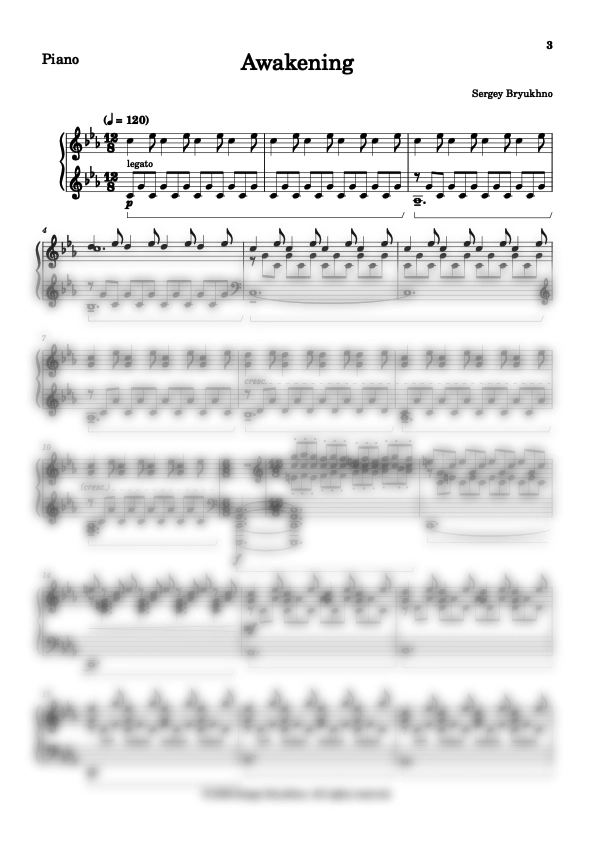
The work spans approximately thirty-five measures and is cast in a continuous, multi-tiered structural wave. It begins with remarkable restraint. The opening establishes a repeated accompanimental figure whose persistence immediately becomes the defining structural principle of the composition. Instead of introducing an elaborate melody, Bryukhno allows harmonic color and subtle registral movement to become the principal agents of expression. The listener's attention is directed toward the gradual alteration of familiar material rather than toward constant novelty.
This approach places the work within a lineage of composers who treat repetition as a constructive force rather than a static device. Yet the repetition here is neither minimalist in the strict sense nor conventionally Romantic. Each recurrence carries slight harmonic or registral modification, allowing time itself to become the primary compositional material.
The harmonic language occupies a compelling position between functional tonality and modern modal practice. Although the music clearly projects a tonal center, it avoids excessive dependence on traditional dominant–tonic rhetoric. Chords frequently derive their expressive quality from spacing, resonance, and voice-leading rather than from strong functional resolution. The prevalence of added tones and open sonorities produces an atmosphere of suspended certainty. Instead of asking where the harmony is going, the listener becomes absorbed in how it changes. This distinction is fundamental to the aesthetic of the piece; motion is generated through evolving sonority rather than through harmonic tension alone.
Equally significant is the economy of motivic material. Rather than introducing multiple contrasting themes, the composition develops a single musical idea through continuous variation. This economy creates immense coherence across the entire work. Every new gesture appears as a consequence of previous material rather than as an interruption of it.
The piano writing demonstrates a refined understanding of idiomatic resonance. The accompaniment is conceived less as accompaniment in the classical sense than as an acoustic field within which melodic fragments emerge. The sustaining pedal becomes an integral compositional element, allowing overtones to enrich the harmonic spectrum and blur strict vertical boundaries. Consequently, the instrument is treated orchestrally rather than merely percussively.
One of the work's greatest strengths lies in its calibrated control of texture and meter. The opening presents transparent layers whose regularity establishes stability in a fluid 12/8 time signature. As the composition progresses, density increases through expanded register, thicker harmonic spacing, and intensified rhythmic activity. However, the rhythmic language does not merely serve as a passive background frame. At key structural junctions, Bryukhno introduces sudden contractions, shifting from 12/8 into an urgent, truncated 6/8 meter (most notably in measures 11 and 31). These metric "hinges" purposefully disrupt the hypnotic flow, acting as primary dramatic parameters that force the music into its climactic states.
Consequently, the piece adopts a two-wave, mirrored arch architecture rather than a single continuous climb. The first metric disruption leads directly to the primary, explosive forte climax (measure 12), marked by highly articulated, alternating block intervals in the extreme upper register. Following this peak, the density settles back into a mezzo-forte texture, initiating a second, more reflective wave of growth. This culminates in measure 32 with a secondary metric compression, yielding a hushed, piano echo of the original high-register motif — a haunting realization of the thematic material before the final descent.
Following this second peak, the composition gradually releases accumulated tension. Rather than offering a decisive conclusion, Bryukhno returns to an atmosphere of contemplation. The closing measures employ a rallentando, suggesting completion without finality and leaving harmonic resonance to continue psychologically after the final pianissimo chord has disappeared. This ending reinforces the title: awakening is portrayed not as an endpoint but as the beginning of a new state of awareness.
From a formal perspective, the structural outline may be understood as:
Introduction of Environment (12/8) → Metric Compression (6/8) → Primary Climax (f) → Resettling & Regrowth → Echo Peak (p) → Reflective Dissolution
Such a design is particularly effective for short contemporary piano works because it permits large-scale direction without relying upon thematic contrast.
Stylistically, the composition occupies an interesting intersection of several contemporary traditions. Certain aspects recall post-minimalist procedures through their reliance on repetition and incremental transformation. Elsewhere, the emphasis on coloristic harmony and sustained resonance evokes twentieth-century French pianism. At the same time, the emotional directness and cinematic pacing place the work comfortably within the modern concert repertoire rather than within academic modernism. Importantly, these influences remain stylistic affinities rather than direct imitations; the work maintains its own compositional identity through its concentration on harmonic atmosphere and gradual formal emergence.
From the standpoint of performance, the principal challenge is not technical virtuosity but control of long-range architecture. A successful interpretation requires the performer to shape extended crescendos with patience, navigate the sudden 6/8 transitions cleanly, and cultivate a wide palette of tonal color. Pedaling must preserve resonance while avoiding harmonic obscurity, particularly during passages where sonorities overlap. The climactic sections must feel organically tied to the metric shifts that precipitate them.
Perhaps the most distinctive quality of Awakening is its refusal to separate structure from expression. The formal process itself embodies the work's emotional narrative. Instead of depicting awakening through illustrative musical gestures, the composition allows listeners to experience awakening as a gradual transformation of musical perception. The piece invites increasingly attentive listening, rewarding sensitivity to minute changes in harmony, texture, and resonance.
In contemporary piano literature, many short works rely upon immediate lyricism or overt virtuosity to establish identity. Bryukhno instead builds identity through patience. The composition demonstrates confidence in limited material, careful pacing, and refined harmonic imagination. Its expressive power arises not from abundance but from concentration. Ultimately, Awakening succeeds because it understands that musical transformation need not depend upon dramatic contrast. Through disciplined control of repetition, evolving harmonic color, and carefully calibrated formal growth, the work achieves an expressive arc that feels both intimate and inevitable.
| Type | Album |
|---|---|
| Release date | 2026-04-03 |
| UPC | 5063720292099 |
| Catalogue number | OCL26040001 |
| Record label | Oclassica — Classical Music Label |


